





Rhema Feast 2026: “Come, Let Us Rebuild” — A Five-Day Call to Spiritual Renewal and National Transformation
By KASS MTV USA News Desk
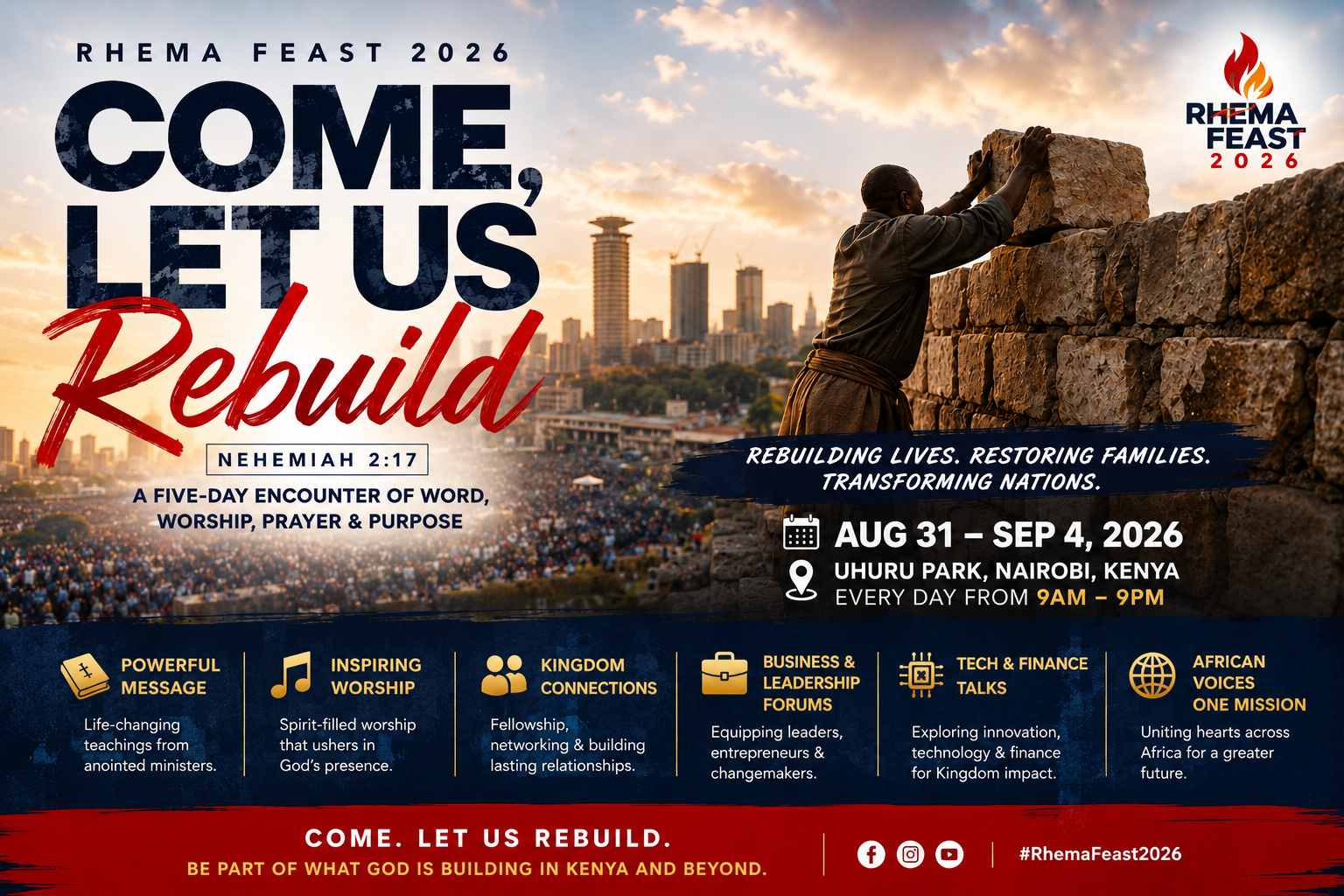
NAIROBI, KENYA — Thousands of Christians are gathering in Nairobi for Rhema Feast 2026, one of the continent’s major Christian gatherings, bringing together ministers, worship leaders, entrepreneurs, church leaders, families and believers from across Kenya and beyond.
Running from August 31 to September 4, 2026, at Uhuru Park in Nairobi, this year’s Rhema Feast is built around a powerful and timely theme:
“Come, Let Us Rebuild”
Drawn from Nehemiah 2:17, the theme is more than a call to construct physical structures. It is a call to rebuild lives, families, communities, institutions, businesses, churches and ultimately the moral and spiritual foundations of a nation.
“Come, let us build the wall of Jerusalem, that we may no longer be a reproach.” — Nehemiah 2:17
For Kenya, a nation facing significant social, economic, generational and leadership questions, the message of rebuilding carries a meaning that reaches far beyond the walls of the church.
Rhema Feast 2026 is therefore emerging not simply as a five-day conference, but as a gathering calling believers to ask an important question:
What needs to be rebuilt in us, around us and within our nation?
The gathering, convened by Reverend Julian Kyula and founded under RUACH Assemblies, brings together voices from Kenya, Nigeria, Uganda, Rwanda, South Africa and other parts of Africa. The programme combines the Word, worship, prayer, fellowship, leadership and enterprise.
The main arena sessions are open to the public and are scheduled to run daily from morning to evening.
DAY ONE: REBUILDING BEGINS WITH THE FOUNDATION
Monday, August 31 — The Call to Rebuild
Every rebuilding project begins with an honest assessment of what has been broken.
The opening day of Rhema Feast 2026 set the spiritual direction for the entire gathering: before rebuilding can begin, there must first be a recognition of the ruins.
Nehemiah did not pretend that Jerusalem was intact. He confronted the reality of broken walls and burned gates. Yet he did not stop at describing the problem. He issued a call to action.
“Come, let us rebuild.”
Day One brought this message into the context of modern life. What happens when faith becomes weak? What happens when families lose their foundations? What happens when young people lose hope? What happens when communities become divided and institutions lose public trust?
The answer suggested by the theme is that rebuilding begins when people stop merely discussing what is broken and begin taking responsibility for restoration.
Among the ministers highlighted on the opening day were Bishop J.B. Masinde and Bishop Funke Felix-Adejumo.
Bishop J.B. Masinde’s teaching focused on the indispensable role of the Holy Spirit in rebuilding. The message emphasised that human strength alone cannot sustain the kind of restoration required in individuals, families and nations.
Bishop Funke Felix-Adejumo brought the rebuilding conversation closer to personal life, examining the importance of rebuilding the altar, the individual, relationships, family and community.
The message was clear:
Before Kenya can rebuild externally, many Kenyans must first rebuild internally.
A healthy nation is ultimately made up of healthy people.
A strong economy requires people of integrity.
Strong families require intentional parents and faithful relationships.
Strong institutions require leaders with character.
And a spiritually healthy society requires individuals who understand that transformation begins in the heart.
The opening day also carried a strong worship dimension, reminding believers that rebuilding is not simply an exercise in human effort but a work that requires dependence on God.
DAY TWO: REBUILDING HOPE AFTER LOSS AND DIFFICULTY
Tuesday, September 1 — When What Was Broken Must Live Again
The second day of Rhema Feast turned the conversation toward one of the most difficult realities of rebuilding: loss.
Rebuilding is never necessary where nothing has been damaged.
For many people, rebuilding follows disappointment.
For others, it follows grief.
For families, it may follow conflict.
For businesses, it may follow failure.
For young people, it may follow seasons of uncertainty and frustration.
Day Two featured a powerful lineup of ministers including Bishop Kathy Kiuna, Apostle Isi Igenegba, Dr. Tumi, Bishop Funke Felix-Adejumo and Apostle Michael Orokpo, among others.
Bishop Kathy Kiuna’s ministry carried particular emotional weight as she reflected on personal loss and the journey of faith after the death of her husband, Bishop Allan Kiuna. Her testimony and ministry offered a picture of rebuilding that goes beyond structures and achievements.
Sometimes rebuilding means learning how to live again.
Sometimes rebuilding means discovering purpose after pain.
Sometimes rebuilding means refusing to allow tragedy to have the final word.
The worship moments throughout the day reinforced another important truth: hope is rebuilt before circumstances are necessarily changed.
For many Kenyans, this message is deeply relevant.
The country has a young population facing questions about employment, opportunity and the future. Families continue to face economic pressure. Businesses are navigating difficult markets. Communities are wrestling with social challenges.
The message of Day Two was therefore not simply, “Everything is easy.”
It was more powerful than that:
Even after loss, there is still something worth rebuilding.
The presence of ministers from different parts of Africa also demonstrated the growing continental nature of Rhema Feast. The challenges facing Kenya are not isolated. Across Africa, communities are asking similar questions about leadership, economic opportunity, family, faith and the future of the next generation.
DAY THREE: REBUILDING THE SOUND, THE MIND AND THE FUTURE
Wednesday, September 2 — Worship, Technology and a New Generation
Day Three of Rhema Feast 2026 represents one of the most distinctive dimensions of this year’s gathering: the connection between faith, worship and the future.
The day includes the “Rebuilding The Sound” Worship Forum, featuring celebrated worship ministers Ntokozo Mbambo and Dr. Tumi.
The conversation around worship is important because every generation has a sound.
Songs shape memory.
Worship shapes culture.
Words shape belief.
The question facing the church is not simply whether it has music, but what kind of spiritual sound is being produced for the next generation.
“Rebuilding The Sound” speaks to the need for worship that is rooted in truth, depth and genuine encounter rather than simply performance.
The same day also looks beyond the traditional boundaries of church through a special Tech Talk: “Decoding the Future of Tech and Finance.”
The session brings together Reverend Julian Kyula and technology and finance leader Seyi Ebenezer to discuss:
- Faith
- Innovation
- Entrepreneurship
- Technology
- Digital finance
- The future of African business
This is one of the clearest examples of how Rhema Feast 2026 is expanding the meaning of rebuilding.
Kenya’s future will not only be determined in political spaces.
It will also be shaped by entrepreneurs.
By innovators.
By software developers.
By business leaders.
By young people creating solutions.
By people who understand technology and use it responsibly.
The question being raised is whether faith can speak meaningfully into this future.
The answer offered by the gathering is yes.
Faith is not meant to be separated from work, innovation and enterprise. Integrity, stewardship, creativity and purpose are all spiritual principles with practical consequences.
For Kenya, a growing technology and innovation hub in Africa, the conversation is particularly significant.
What kind of businesses are we building?
What values will shape the digital economy?
Will innovation create opportunity for more people or only wealth for a few?
Can African entrepreneurs build successful businesses without sacrificing integrity?
These are not only business questions. They are questions of national character.
Day Three therefore connects the altar with the marketplace and worship with innovation.
DAY FOUR: REBUILDING CONNECTIONS ACROSS AFRICA
Thursday, September 3 — Faith, Culture, Business and Influence
Day Four continues the rebuilding conversation beyond the individual and into relationships between people, nations and markets.
A major feature of the day is The X-Change, a forum bringing together Kenyan and Nigerian voices around the intersection of faith, culture, business and influence.
The gathering features a diverse group of leaders and professionals, including:
- Polycarp Igathe
- Rev. Julian Kyula
- Cynthia Nyamai
- Dr. Wale Akinyemi
- Hadassah Esther
- Susan Elisha
- Ikechukwu Arthur Anoke
- Mary Mulili
The forum also explores business connections between Kenya and Nigeria.
This matters because Africa’s future cannot be built through isolation.
The continent is increasingly interconnected.
A business idea in Nairobi can find customers in Lagos.
A creative brand in Kenya can influence audiences in Johannesburg.
Technology is breaking geographical barriers.
Young Africans are increasingly building businesses and communities that cross national borders.
The X-Change therefore reflects another dimension of rebuilding:
Africa must rebuild confidence in itself and strengthen connections among its people.
The inclusion of business discussions alongside faith and culture also sends an important message to Christians in the marketplace.
The church does not exist outside society.
Believers are teachers.
Doctors.
Entrepreneurs.
Artists.
Engineers.
Journalists.
Technology professionals.
Public servants.
Parents.
Business owners.
And wherever believers are present, they have an opportunity to influence their environment.
Rebuilding Kenya, therefore, cannot be left to one group of people.
It requires responsible participation across every sector.
The message of Day Four is that influence must become constructive.
Faith must become visible in character.
And purpose must produce practical impact.
DAY FIVE: REBUILDING WHAT WILL OUTLAST US
Friday, September 4 — Capital, Calling and Building for the Future
The final day of Rhema Feast 2026 brings particular focus to enterprise and long-term impact.
The Rhema Feast Business Forum explores a theme that is increasingly important for Kenya and Africa:
Enterprise as an altar
The forum focuses on areas including:
- Capital and Calling
- Building to Outlast You
- Governance and Integrity
- The Founder’s Interior Life
This approach challenges a common assumption that business success is only about making money.
Profit is important.
Growth is important.
But the question of how something is built is equally important.
Can a business grow with integrity?
Can an entrepreneur succeed without exploiting employees?
Can leaders build organisations that survive beyond their personalities?
Can wealth be used responsibly?
Can businesses create jobs, strengthen communities and contribute to national development?
These questions are particularly relevant to Kenya, where entrepreneurship remains a major source of employment and economic opportunity.
Kenya’s rebuilding will require more than government programmes.
It will require businesses that create jobs.
Entrepreneurs who innovate.
Leaders who practise good governance.
Professionals who work with integrity.
And citizens who understand that long-term transformation requires patience.
The Business Forum therefore represents the practical side of the Rhema Feast message.
Rebuilding requires builders.
And builders need wisdom, character, vision and endurance.
The final day also carries the wider spiritual significance of completing what has been started.
Nehemiah’s story was not simply about beginning to build.
It was about persevering until the work was completed.
That is perhaps one of the most important lessons for Kenya.
The country has many ideas.
Many plans.
Many conversations.
Many promises.
But national transformation requires consistency.
It requires finishing what we begin.
It requires institutions that outlive individuals.
And it requires a generation willing to build for people they may never meet.
THE VOICES OF RHEMA FEAST 2026
Rhema Feast 2026 brings together a broad group of Christian ministers and worship leaders from across Africa.
Among the confirmed and announced Word ministers are:
- Reverend Julian Kyula — Kenya
- Apostle Joshua Selman — Nigeria
- Apostle Michael Orokpo — Nigeria
- Apostle Grace Lubega — Uganda
- Pastor Poju Oyemade — Nigeria
- Dr. David Ogbueli — Nigeria
- Bishop J.B. Masinde — Kenya
- Bishop Funke Felix-Adejumo — Nigeria
- Bishop Kathy Kiuna — Kenya
- Apostle Mignonne Kabera — Rwanda
- Apostle Felix Okoh — South Africa
- Pastor T. Mwangi — Kenya
- Pastor George Macharia — Kenya
The worship programme includes prominent ministers and artistes such as:
- Sinach
- Dunsin Oyekan
- Dr. Tumi
- Ntokozo Mbambo
- Jaque Gachiri
- Kestin Mbogo
- Njoki Munyi
- Moji Short Babaa
Together, the lineup reflects a gathering that is both Kenyan and continental.
Kenya is hosting voices from across Africa, while Kenyan ministers are also standing alongside them.
This is significant because it presents Kenya not merely as a consumer of international ministry but as an important meeting point for faith, leadership, worship and ideas within Africa.
WHAT RHEMA FEAST 2026 MEANS FOR KENYA
The question many people may ask is simple:
What does a five-day Christian gathering mean for the country beyond the event itself?
The answer depends largely on what happens after the worship ends.
The theme, “Come, Let Us Rebuild,” challenges believers to carry the message beyond Uhuru Park.
1. Kenya Needs Spiritual Rebuilding
Rebuilding begins with values.
A society cannot be transformed only through policies if corruption, dishonesty, greed and selfishness continue to dominate personal choices.
The call to rebuild therefore begins with the individual.
Who am I when nobody is watching?
Can I be trusted?
Do I practise integrity in my work?
Am I contributing to the problem or becoming part of the solution?
Spiritual renewal becomes meaningful when it produces transformed character.
2. Kenya Needs Stronger Families
Families remain the foundation of society.
When families are under pressure, children, communities and institutions often feel the consequences.
The rebuilding message therefore includes fathers rebuilding relationships with children.
Mothers rebuilding hope.
Couples rebuilding trust.
Young people rebuilding a vision for their future.
Families rebuilding prayer and communication.
The future of Kenya will be influenced not only by what happens in Parliament or corporate boardrooms, but also by what happens around the dinner table.
3. Kenya Needs a Generation That Builds Instead of Only Criticising
Nehemiah did not merely complain about Jerusalem.
He organised.
He mobilised.
He built.
Kenya’s young people have energy, creativity and a growing awareness of the issues facing the country.
The challenge is to transform that awareness into constructive action.
Rebuilding Kenya means:
Starting businesses.
Developing solutions.
Serving communities.
Holding leaders accountable.
Participating responsibly in society.
Creating art.
Building technology.
Mentoring others.
And refusing to surrender the future to hopelessness.
4. Kenya Needs Integrity in Leadership and Business
One of the strongest practical messages surrounding Rhema Feast 2026 is the relationship between faith and leadership.
A person can speak about God on Sunday and still have to demonstrate integrity on Monday.
That is where rebuilding becomes real.
Kenya needs leaders whose private character can support their public influence.
The country needs businesses that create value without exploiting people.
It needs institutions built on systems rather than personalities.
It needs professionals who understand that excellence is also a form of worship.
5. Kenya Can Become a Meeting Point for Africa
The presence of ministers, worship leaders and professionals from different African countries demonstrates Kenya’s ability to host major continental conversations.
Events such as Rhema Feast bring people together across borders.
They create spiritual relationships.
They encourage tourism and hospitality.
They generate business connections.
They strengthen Kenya’s position as a regional centre.
But beyond economics, they also create something more difficult to measure:
shared African hope.
When Africans gather to worship, learn, discuss business and exchange ideas, they begin to see one another not simply as citizens of different countries but as people facing many common challenges and sharing many common opportunities.
THE REBUILDING BEGINS AFTER THE FEAST
Perhaps the greatest measure of Rhema Feast 2026 will not be the size of the crowd.
It will not only be the power of the worship.
It will not simply be the number of famous ministers on stage.
The real question will be:
What happens when people go home?
Will families be different?
Will businesses be run differently?
Will young people pursue purpose with greater determination?
Will leaders choose integrity?
Will churches become stronger communities of service?
Will Christians become builders in society?
That is where the message of “Come, Let Us Rebuild” becomes personal.
The walls of Kenya will not be rebuilt by one person.
Like the builders in Nehemiah’s day, different people must take responsibility for different sections.
The teacher has a wall to rebuild.
The pastor has a wall to rebuild.
The entrepreneur has a wall to rebuild.
The parent has a wall to rebuild.
The journalist has a wall to rebuild.
The politician has a wall to rebuild.
The young person has a wall to rebuild.
The question is no longer simply:
“What is wrong with Kenya?”
The greater question is:
“What has God placed in my hands to rebuild?”
As Rhema Feast 2026 continues in Nairobi, that question may become its most enduring message.
For a nation searching for stronger foundations, renewed hope and a more responsible generation of leaders, the call from Nehemiah continues to echo across the years:
Come. Let Us Rebuild.
And perhaps Kenya’s rebuilding begins when every person decides that somebody else does not have to start first.
