






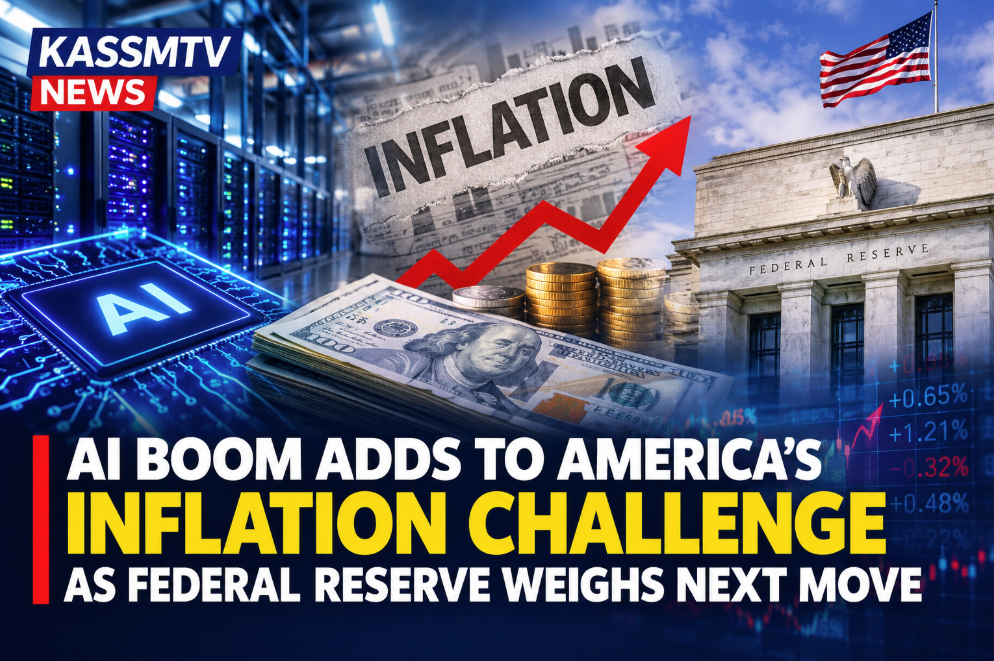
AI Boom Adds to America’s Inflation Challenge as Federal Reserve Weighs Next Move
By KASSMTV News | October 19, 2026
America’s artificial intelligence boom is creating a fresh challenge for policymakers as rising technology investments add to inflationary pressures, complicating the Federal Reserve’s efforts to bring prices under control.
In a report published on Monday, Reuters said Federal Reserve officials are increasingly acknowledging that heavy spending on artificial intelligence infrastructure is contributing to demand and price pressures across the economy.
The development raises concerns that efforts to control inflation could place additional financial pressure on households, small businesses and companies that depend on borrowing.
AI Investment Fuels Demand
Technology companies are committing enormous sums to data centres, computing equipment and infrastructure needed to develop and operate advanced AI systems.
The investment has benefited technology businesses and suppliers while supporting demand for construction, electricity, computer chips and other equipment.
However, when spending grows faster than the economy’s capacity to supply goods and services, it can contribute to inflationary pressures.
The challenge for policymakers is that the AI sector’s investment boom may continue even as higher interest rates begin to slow activity elsewhere.
Federal Reserve Faces a Difficult Balancing Act
The Federal Reserve is tasked with maintaining price stability while supporting maximum employment.
One of its main tools is the adjustment of interest rates. Higher borrowing costs can reduce demand by making mortgages, business loans and credit more expensive.
But this approach can affect different parts of the economy unevenly.
Large technology companies with substantial financial resources may continue investing despite higher rates, while smaller businesses and households could face greater difficulties accessing affordable credit.
Housing and other interest-sensitive sectors may also experience slower activity as financing costs rise.
Reuters reported that Federal Reserve officials were discussing how to address persistent inflation without unnecessarily damaging employment or economic growth.
What It Means for American Households
For consumers, the consequences could extend beyond the technology industry.
If inflation remains elevated, the Federal Reserve may have less room to reduce interest rates. If borrowing costs rise or remain high, households could face more expensive loans, while small businesses may delay expansion or hiring.
At the same time, continued investment in AI could create opportunities in technology, energy, infrastructure and related industries.
The challenge is ensuring that the benefits of the investment boom are not accompanied by sustained price pressures that weaken purchasing power.
Markets Watch the Federal Reserve
Investors are closely monitoring inflation data and signals from central bank officials for clues about the next interest-rate decision.
Reuters reported that the Federal Reserve was scheduled to meet on October 27–28, with officials weighing the inflation outlook and the risks associated with tighter financial conditions.
The central bank’s decisions could influence stock markets, borrowing costs, business investment and consumer spending in the months ahead.
For now, the AI boom presents a complicated picture: it is attracting substantial investment and supporting parts of the economy, while potentially making the fight against inflation more difficult.
KASSMTV News will continue following developments in the U.S. economy, artificial intelligence investment and Federal Reserve policy.
Source: Reuters — Fed sees AI boom adding to inflation headache
