







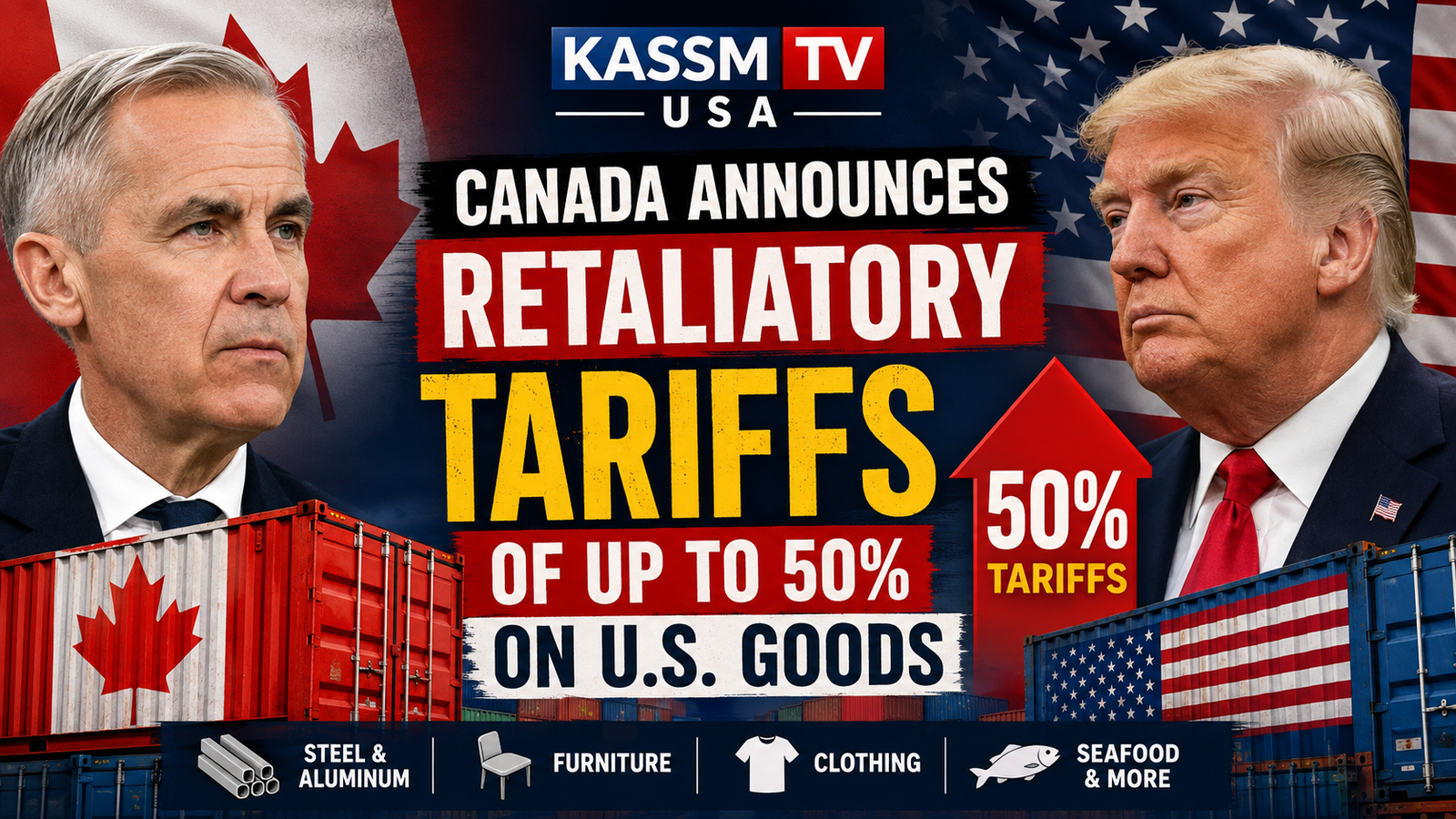
Canada Announces Retaliatory Tariffs of Up to 50% on U.S. Goods
Reported by KASSM TV USA
WASHINGTON — Canada has announced a new round of retaliatory tariffs of up to 50% on a wide range of U.S. products, escalating tensions with the Trump administration after trade negotiations between the two countries broke down.
Canadian officials said Tuesday that the new measures will target nearly C$28 billion (about US$20 billion) worth of American goods. The tariffs are expected to take effect on September 8 and are designed to mirror the value and categories of Canadian products currently facing higher U.S. tariffs.
The targeted products include steel and aluminum, furniture, clothing, cosmetics, appliances, dairy products, seafood, tools and machinery.
Canada’s Finance Minister François-Philippe Champagne described the measures as a proportionate and strategic response to tariffs imposed by the Trump administration.
“Canada must respond,” Champagne said, warning that the U.S. tariffs would have consequences for Canadian workers, businesses and communities.
Canada Targets Nearly 900 U.S. Products
Canadian authorities released a list of almost 900 American products that will face additional duties.
Among the measures are:
- 50% tariffs on steel and aluminum products that had previously faced a 25% Canadian tariff.
- 50% tariffs on selected products including honey, furniture, clothing, cosmetics and perfumes.
- 25% tariffs on appliances such as dishwashers and washing machines, as well as dairy products, fish, seafood and certain steel and aluminum derivatives.
- 15% tariffs on selected tools and machinery, including forklifts and air-conditioning equipment.
Canadian officials said the products were selected partly because alternative suppliers may be available, potentially reducing the impact on Canadian consumers and businesses.
Canada Announces Billions in Support
The Canadian government also announced an additional C$7.5 billion in support programmes for workers and businesses affected by the trade dispute.
The funding is intended to help companies remain operational, protect jobs and cushion communities from the economic impact of higher trade costs.
However, economists and businesses warn that prolonged tariffs could hurt both countries because Canada and the United States have deeply integrated supply chains built over decades.
Higher costs could eventually be passed on to manufacturers, retailers and consumers on both sides of the border.
Trump Fires Back
The White House said the United States had offered Canada the possibility of what it described as “the most preferential market access of any country on Earth” during recent negotiations.
Instead, the White House accused Canada of making unreasonable demands and walking back commitments during the talks.
President Donald Trump also sharply criticized Canada in posts on Truth Social, accusing the country of taking advantage of the United States and imposing high tariffs on American agricultural products.
Trump wrote that Canada has been one of the most difficult countries with which to negotiate and suggested that the United States could further reduce trade with Canada.
He also floated the provocative idea of renaming Lake Ontario “Lake America.”
Trump has additionally threatened to increase U.S. tariffs on Canadian automobiles to 50% beginning January 1.
Carney Warns of Damage to Canadian Industry
Canadian Prime Minister Mark Carney has accused Trump of seeking to damage major Canadian industries, including automobile manufacturing as well as the steel and aluminum sectors.
The dispute has also raised fresh concerns about the future of the United States-Mexico-Canada Agreement (USMCA), the North American trade pact governing much of the region’s commerce.
Mexico is also closely monitoring the situation. Mexican President Claudia Sheinbaum sent Economy Secretary Marcelo Ebrard to Washington for emergency discussions following the collapse of the latest trade negotiations.
Calls for Negotiations to Resume
Despite increasingly heated rhetoric from both sides, some Canadian officials have signaled that negotiations could still resume.
Ontario Premier Doug Ford, who had strongly criticized Trump earlier in the dispute, said he remains interested in reaching an agreement that benefits both Americans and Canadians.
The latest escalation has generated concern among businesses that a prolonged trade war could disrupt investment, supply chains and employment.
For consumers, the biggest concern is the potential for higher prices as companies on both sides of the border absorb or pass on the additional costs.
With Canada and the United States among each other’s largest trading partners, the economic consequences of the dispute could extend well beyond the products directly targeted by the new tariffs.
KASSM TV USA will continue to monitor developments as Canada, the United States and Mexico navigate the escalating North American trade dispute.
