







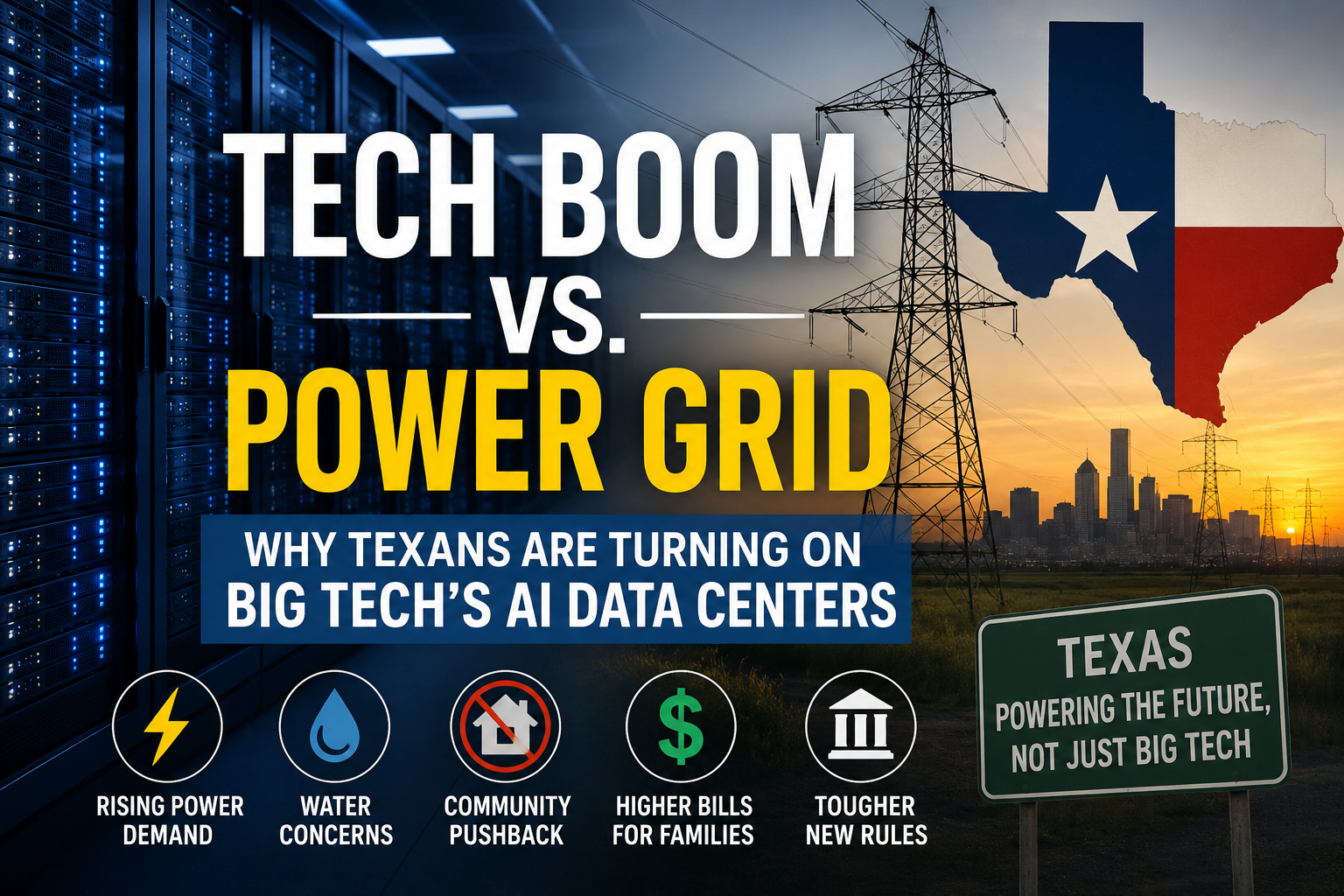
Tech Boom vs. Power Grid: Why Texans Are Turning Against Big Tech’s AI Data Centers
By KASSM TV USA
TEXAS — Texas was once hailed as the next global powerhouse for artificial intelligence infrastructure. With abundant land, relatively cheap energy and a business-friendly environment, the state attracted billions of dollars in investments from technology companies racing to build massive AI data centers.
But the mood is changing.
A growing backlash from residents, local governments and state officials is putting the brakes on the rapid expansion of hyperscale data centers. Concerns over electricity demand, rising utility bills, water consumption, noise and the impact on residential communities are turning what was once a celebrated technology boom into a major political and economic battle.
Texas Faces a Massive Power Demand Challenge
At the heart of the controversy is the sheer amount of electricity required to operate AI data centers.
The Electric Reliability Council of Texas (ERCOT), which manages most of the state’s electricity grid, has reported hundreds of gigawatts of proposed projects waiting to connect to the system.
Data centers make up the overwhelming majority of those new electricity requests.
The scale has raised concerns about whether Texas can expand its power infrastructure quickly enough to accommodate the AI industry without putting additional pressure on the grid or increasing costs for ordinary electricity customers.
For Texans already dealing with fluctuating electricity prices, the prospect of massive new industrial users competing for power has become a major concern.
Abbott Takes a Harder Line on Data Centers
Texas Governor Greg Abbott has taken a significantly tougher position on new data center developments, calling for greater scrutiny of projects seeking connections to the state’s electricity grid.
The governor has argued that technology companies must demonstrate that their developments will benefit rather than burden surrounding communities.
Abbott has also criticized data center developers for attempting to locate massive facilities close to residential neighborhoods without adequately addressing concerns over electricity, water use, noise and infrastructure.
The message from the state leadership is increasingly clear: Texas is still open to technology investment, but developers will have to play by tougher rules.
New Rules Put Pressure on Developers
Under the state’s emerging approach to data center development, companies are being pushed to meet several conditions designed to protect communities and the power grid.
Among the key expectations are:
- Data centers should not increase electricity costs for residential customers.
- Developers should pay the full cost of infrastructure required to serve their facilities.
- Companies should adopt more water-efficient cooling technologies, including closed-loop systems where appropriate.
- New facilities should maintain appropriate distances from residential neighborhoods.
- Developers are expected to address noise and other community impacts.
The tougher requirements are already affecting projects.
One major East Texas development by Diode Ventures was withdrawn after the project failed to meet the standards set by the governor’s office.
Texans Increasingly Question the AI Gold Rush
The opposition is not limited to one political party.
A University of Texas/Texas Politics Project poll found that 56% of Texas voters oppose data center construction in their communities, reflecting growing public concern about the impact of large-scale AI infrastructure.
The backlash has brought together groups that do not always agree politically.
Rural conservatives worried about land, water and electricity costs are finding common ground with urban residents concerned about environmental impacts and neighborhood development.
Local Governments Push Back
Across Texas, communities are increasingly using local regulations to slow or control data center construction.
Some cities have introduced stricter zoning requirements, larger setbacks and noise restrictions to keep industrial-scale facilities away from residential neighborhoods.
Other communities are focusing on water.
In San Marcos, concerns about the amount of water required to cool large server installations contributed to opposition to a proposed rezoning.
Meanwhile, some municipalities have introduced temporary moratoriums on new data center applications while they study the potential impact on infrastructure and natural resources.
The debate has also reached the highest levels of state politics, with prominent officials calling for stronger oversight of the rapidly expanding industry.
Why AI Data Centers Need So Much Power
The explosive growth of artificial intelligence is changing the economics of data centers.
Traditional cloud computing facilities already require substantial amounts of electricity. AI systems can demand even more power because they rely on large numbers of specialized processors operating continuously.
As companies develop increasingly powerful AI models, demand for computing capacity is expected to grow.
That means Texas faces a difficult balancing act.
The state wants to attract billions of dollars in investment and position itself as a leader in the AI economy. At the same time, officials must ensure that the electricity grid, water supplies and local communities can handle the additional demand.
A Warning to Silicon Valley and Big Tech
Texas’ changing position could have major consequences for the technology industry.
According to BloombergNEF data cited in the debate, the state’s restrictions could affect approximately 49.8 gigawatts of planned data center capacity, representing a significant portion of the U.S. development pipeline.
Industry groups have indicated that data center operators are prepared to work within the state’s new requirements.
But the era of simply finding cheap land, securing electricity and building enormous computing facilities may be coming to an end.
Companies will increasingly be expected to demonstrate how they will pay for the infrastructure they require, conserve water, reduce noise and protect nearby communities.
The Bigger Question: Who Pays for the AI Revolution?
The Texas debate raises a question that extends far beyond the Lone Star State:
Who should pay for the infrastructure required to power the artificial intelligence revolution?
Technology companies argue that data centers create jobs, attract investment and establish the infrastructure needed for America’s leadership in AI.
Critics counter that residents should not be forced to shoulder higher electricity bills, depleted water resources or unwanted industrial development simply to support the growth of technology companies.
For Texas, the challenge is finding a middle ground between economic opportunity and community protection.
The state may still become a major global center for AI infrastructure—but the political message coming from Austin and communities across Texas is increasingly clear:
The AI boom can continue, but not at any cost.
KASSM TV USA will continue to follow the growing debate over artificial intelligence, energy infrastructure, technology investment and the impact of Big Tech on communities across America.
